
By Val de Albuquerque
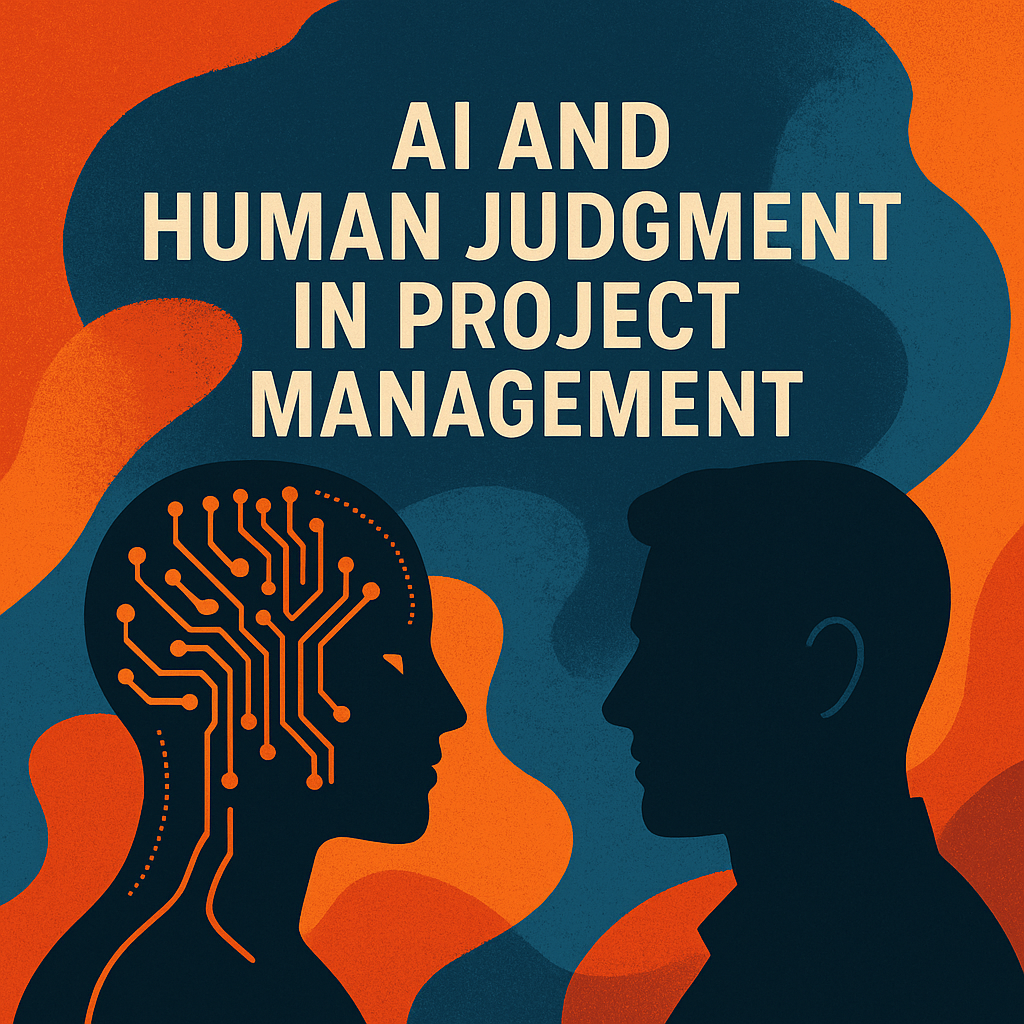
AI and Human Judgement In Project Management, what is the relevance?
Artificial Intelligence is changing how we manage time, risk, and decisions.
Project management platforms can now forecast delivery dates, predict blockers, assess performance, and even write reports — all in seconds.
But as AI becomes more embedded in our tools, a deeper question emerges:
Are we becoming too dependent on it — and losing the subtle art of human judgment?
In this new phase of the Beyond Relevance series, we explore how project managers, Scrum Masters, and leaders can strike the right balance between the analytical precision of AI and the emotional intelligence that defines great leadership. Let´s start with Data.
When Data Can’t See the Human Factor
AI can analyze thousands of data points but can’t sense tension in a meeting, detect burnout, or read the silence after a difficult sprint.
When project managers rely solely on AI-generated insights, they risk missing the nuances that keep teams functional and motivated.
A model might predict “on-time delivery,” while the team behind it quietly crumbles under pressure.
AI can show progress, but only humans can feel it.
That’s why emotional awareness, empathy, and observation remain critical leadership skills — not despite AI, but because of it.
But how do I do next?
Training Project Managers to Challenge AI
The best PMs know that AI is an advisor, not an oracle.
Scenario-based learning — real simulations, not just theoretical courses — helps PMs learn when to trust data and when to question it.
A well-trained manager doesn’t accept an AI’s recommendation blindly. They validate it through:
- Team feedback and firsthand experience.
- Contextual cues (client tone, organizational culture, historical challenges).
- Ethical considerations and stakeholder impact.
AI may accelerate insight, but wisdom still requires friction — the moment of pause where a leader asks, “Does this make sense for my team?”
The Unshakable Value of Soft Skills
Soft skills are no longer “nice to have.”
They’re the bridge between machine-generated efficiency and human-driven success.
Communication, negotiation, conflict resolution, and cultural awareness amplify the value of AI by contextualizing it.
They help managers interpret signals that no algorithm can translate — trust, morale, intention.
AI can optimize a sprint plan, but only human empathy can keep a team engaged enough to execute it. Then how can I trust it?
Trust in the Age of Intelligent Decisions
Stakeholders trust leaders who use AI with judgment — not in place of it.
When data is used without context, credibility erodes.
AI may help shorten decision cycles, but in the end, accountability remains human.
As leaders, we own the “why,” not just the “what.”
We decide what to prioritize, what to pause, and what to protect.
The best governance models clearly define:
- Where AI’s role ends and human judgment begins.
- When decisions require manual validation (especially those affecting people, culture, or strategy).
- How to audit AI outputs for bias and ethical soundness.
AI should inform decisions, not define them.
Where AI and Humans Work Best Together
In real-world projects, AI and humans each have their strengths:
At the start:
Humans interpret client nuances, align expectations, and translate them into meaningful scope — AI can’t replace that empathy or context.
During execution:
AI excels at consolidating performance data, estimating effort, and highlighting risk trends — freeing leaders to focus on communication and alignment.
When conflict arises:
AI can identify patterns, but humans resolve tension through dialogue, trust, and cultural sensitivity.
Used this way, AI sharpens decision while human judgment ensures they succeed.
The Evolution of Project Methodologies
Project management will increasingly become a hybrid discipline — blending AI-driven precision with human-led adaptability.
Frameworks like Scrum and SAFe will evolve to include:
- AI-supported analytics, forecasting, and sprint optimization.
- Human checkpoints for ethical, cultural, and strategic validation.
- Formal emphasis on soft skills and leadership as measurable competencies.
AI should become the engine that drives delivery,
while human judgment remains the compass that sets direction.
Beyond Automation — Toward Augmentation
The future of work isn’t defined by AI replacing managers.
It’s defined by managers learning to co-create with AI — transforming data into decisions, and insights into impact.
Just as AI redefines how we build products, it also redefines how we lead people.
Our greatest challenge — and opportunity — lies in maintaining humanity at the core of intelligent systems.
Because no matter how advanced AI becomes,
judgment, empathy, and integrity will always be human superpowers.
💬 Join the conversation:
How do you balance AI insights with human judgment in your daily decisions?
Where do you draw the line between automation and intuition?
Let’s design the future of leadership — together.
#AI #ProjectManagement #AgileLeadership #ScrumMaster #FutureOfWork #Automation #DecisionMaking #HumanIntelligence #Leadership #BeyondRelevance #ArtificialIntelligence #EthicsInAI